The Bradenton Small Business Guide to Getting Found Online (Google, Maps & AI Search)
Getting Found
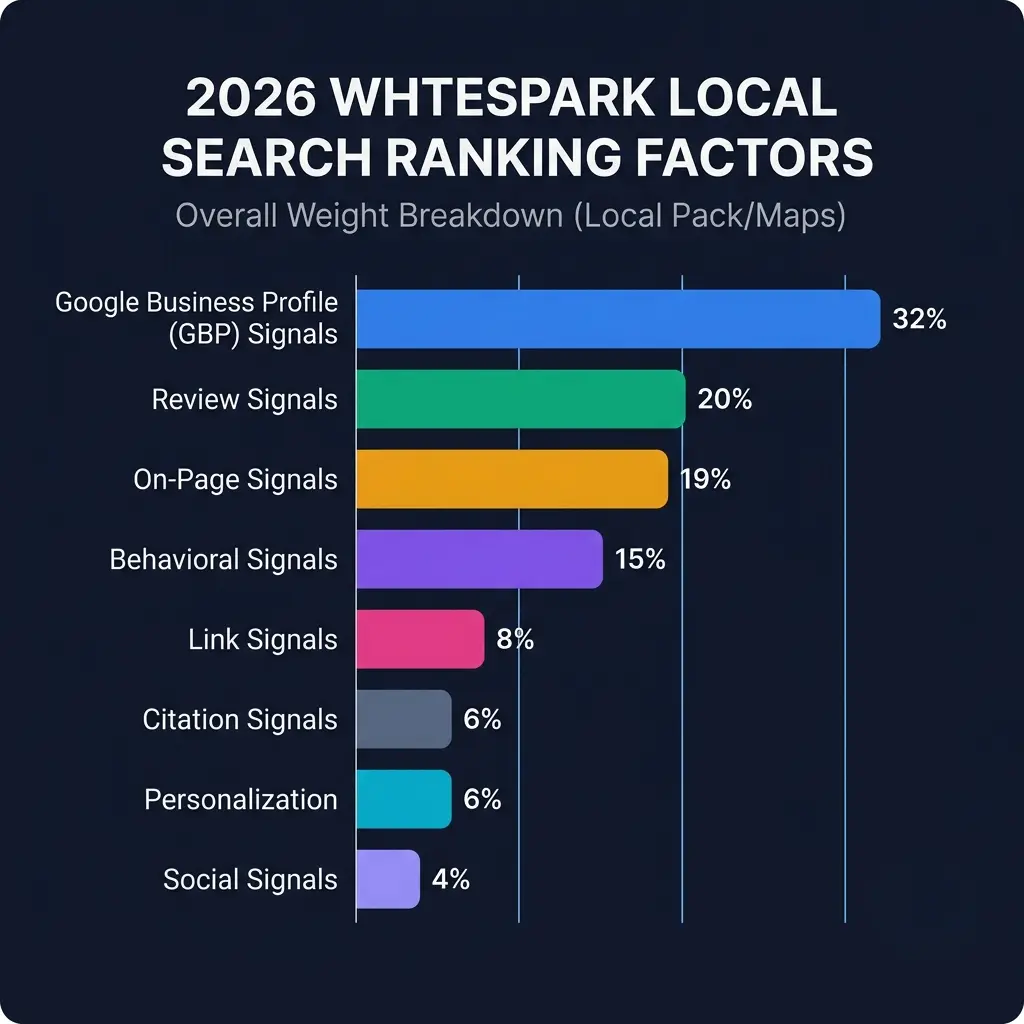
Getting found online used to mean one thing: ranking on Google. It now means three things at once. Google's regular results, the map pack tied to your Google Business Profile, and a growing share of AI Overviews and chatbot answers that skip the results page entirely. Google Business Profile signals alone drive 32% of local ranking weight (Whitespark 2026 Local Search Ranking Factors), and AI Overviews now appear in 68% of local business-type searches (Whitespark, 2026).
This guide covers what actually determines whether a Bradenton or Manatee County business shows up on Google, on Maps, and increasingly inside ChatGPT and Perplexity answers. It's built to give you the real picture before we ever launch a paid SEO service, not to sell you one that doesn't exist yet.
Key Takeaways
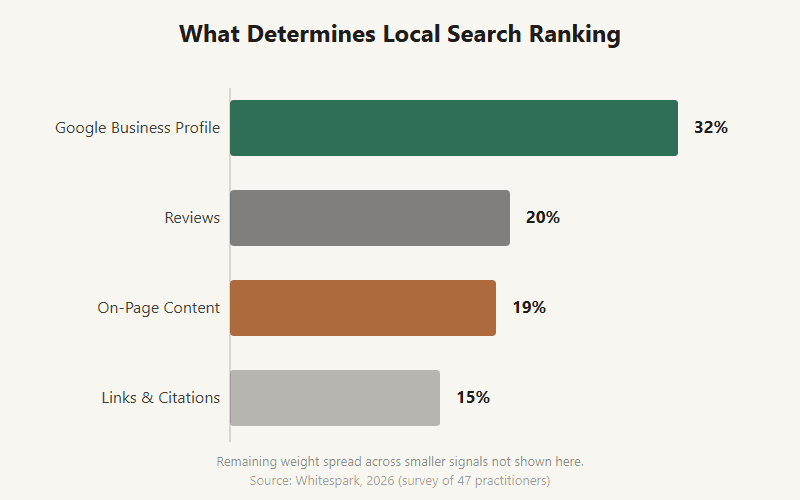
Google Business Profile signals make up 32% of local ranking weight, reviews 20%, on-page content 19%, and links 15% (Whitespark, 2026).
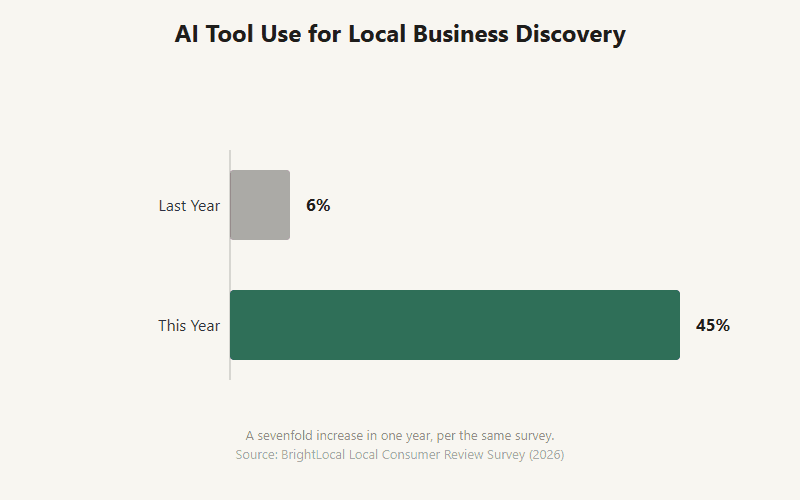
AI Overviews now appear in 68% of local business searches, and 45% of consumers used ChatGPT or a similar AI tool to find a local business this year. Up from just 6% a year earlier (Whitespark; BrightLocal, 2026).
None of this requires a paid SEO service to start. An accurate Google Business Profile, consistent business details, and a website built to be readable by both search engines and AI count for most of it.
What Actually Determines Whether You Show Up in Local Search?
Google Business Profile signals make up 32% of local ranking weight, the single biggest factor, with reviews at 20%, on-page website content at 19%, and links and citations at 15% (Whitespark 2026 Local Search Ranking Factors, survey of 47 local SEO practitioners). In plain terms: your free Google listing and your reviews outweigh almost everything else on your actual website.
Most Bradenton business owners we talk to assume their website is the main lever. It's one lever, and a smaller one than the free Google listing they've usually barely touched. For the full breakdown of how each factor works together, see how local SEO works for Manatee County small businesses.
Is Your Google Business Profile Actually Complete?
A Google Business Profile is the free listing with a map pin that shows your hours, photos, reviews, and a link to your site whenever someone searches for your business or service nearby. And given that it's 32% of your ranking weight, an incomplete one is the single most common reason a real, legitimate business doesn't show up. Most owners set one up once at launch and never touch it again.
A complete profile has accurate categories, real photos (not stock images), correctly formatted hours including holiday hours, a filled-out business description, and posts or updates added periodically rather than left dormant. Google reads an actively maintained profile as a signal of a real, currently operating business, not just a checkbox.
The category field trips up more Bradenton businesses than anything else on the profile. A primary category that's technically accurate but too broad, "Contractor" instead of "Roofing Contractor," "Restaurant" instead of "Seafood Restaurant", makes Google guess at what you actually do, and a guess is exactly what a fully specified category is supposed to eliminate. It's a five-minute fix with an outsized effect on which searches you show up for.
A business without a public storefront (a mobile detailer, a home-based bookkeeper) sets the profile up as a service-area listing instead of a street address. That's a normal, correct configuration, not a workaround. A full walkthrough of exactly what to fill in and in what order lives in our Google Business Profile checklist.
What Are AI Overviews, and Why Do They Matter for Your Business?
AI Overviews, the AI-generated summary Google shows above regular search results, now appear in 68% of local business-type searches, ranging from 57% to 80% depending on the industry (Whitespark, 2026, based on a manual study of 540 queries across three U.S. cities). That's a lot of local searches where the AI-generated answer, not the blue links below it, is the first thing a customer sees.
We watch this shift show up in a simple way on real client calls: business owners increasingly say they "asked ChatGPT" or "Googled it and the AI answer said" something about a competitor, rather than describing a normal search results page. The behavior has already changed for a meaningful share of your customers, whether or not your own habits have caught up yet.
AI Overviews pull from the same entity data search engines already trust. Your Google Business Profile, your site's structured data, and consistent business details across the web. A business that's clear and consistent about who it is and what it does gives an AI Overview something solid to summarize; a business with mismatched or thin information often gets left out of the summary entirely.
How Do ChatGPT and Perplexity "See" a Local Business?

Use of ChatGPT and similar AI tools for local business recommendations rose from 6% of consumers a year ago to 45% this year (BrightLocal Local Consumer Review Survey, 2026), making AI the third most-used discovery channel behind only Google and Facebook. 40% of consumers now trust AI platforms to provide business recommendations, and 42% trust them as much as traditional reviews (BrightLocal, 2026).
ChatGPT and Perplexity don't crawl the web the way Google does — they lean on a mix of licensed data, live search results, and structured entity information to describe a business. That means the same fundamentals that help Google trust you (accurate NAP data, real reviews, clean structured data) are largely the same fundamentals that get you described correctly in an AI answer, not a separate project. More on how to actually improve your odds here in how ChatGPT and Perplexity "see" a local business.
NAP Consistency: The Basic Most Local Sites Get Wrong
NAP, your business Name, Address, and Phone number, needs to match exactly everywhere it appears online: your website, your Google Business Profile, Yelp, Facebook, and any local directory. Citation and link signals make up 15% of local ranking weight in Whitespark's 2026 breakdown (Whitespark, 2026), and mismatched NAP data is one of the most common reasons that signal gets weaker than it should.
A suite number dropped on one listing, an old phone number lingering on another, "St." versus "Street" inconsistently used. None of these look like a big deal to a person, but they read as conflicting evidence to a system trying to confirm you're a single, real, trustworthy business. This is also the single most common mistake we see across Manatee County business listings when we run an audit, alongside duplicate or abandoned old listings from a previous address or a rebrand.

A quick way to check your own: search your exact business name in Google and look at every result, then search your phone number on its own. A moved business, a renamed business, or one that changed phone providers often has a stray old listing still live somewhere, quietly contradicting the current, correct one. A full mistake-by-mistake walkthrough is coming in local SEO mistakes we see in Manatee County websites.
Bradenton, Manatee County, or Anna Maria Island? Getting Your Local Keywords Right
The right local keyword depends on how your actual customers describe where they are, not which name sounds most official. A Bradenton contractor who only ever writes "Manatee County" is optimizing for a phrase almost nobody types into Google, while a business actually serving Anna Maria Island tourists needs that specific name on the page, not just "the Bradenton area" as a stand-in for it.
We see this most often with businesses that serve a wider service area than their city name suggests, or the reverse. A business that only serves one specific neighborhood but writes copy as if it covers the whole county. Neither search engines nor AI tools can target a service area you haven't actually named on the page.
A charter boat operator based in Cortez but running trips out to Anna Maria Island needs "Anna Maria Island" stated plainly on the page a tourist actually searches from, not just "Bradenton" as a catch-all. A Lakewood Ranch accountant serving clients across the county benefits from naming Manatee County directly, since that's the phrase a business owner outside Bradenton proper is more likely to type. The right approach is usually all three names, used honestly for the areas you actually serve, not stuffed in for coverage. This gets a full treatment in targeting the right local keywords across Bradenton, Manatee County, and Anna Maria Island.
Schema Markup: The Invisible Signal Most Sites Skip
Schema markup, structured data added to a page's code that isn't visible to a visitor, can lift organic click-through rate by 30% to 82% when implemented correctly, according to Google's own case studies (via TheBomb, 2026). It's also increasingly how AI systems confirm what a business actually is, rather than guessing from unstructured page text.
Partial schema implementation produces little to no rich-result lift. Completeness matters more than simply having some markup present. A page with full LocalBusiness schema (name, address, hours, category, reviews) gives both Google and AI tools clean, verifiable data to work with; a page with none of it forces them to guess, and guessing means getting left out.
This is one of the few items on this page you genuinely can't do yourself without touching code, which is why we build LocalBusiness and Organization schema into every site we launch by default rather than treating it as an add-on. It's invisible to a visitor and easy to overlook precisely because nobody notices it's missing, until a competitor's stars and hours are showing in search results and yours aren't. More detail, in plain language, in schema markup explained for Bradenton business owners. No code required to understand what it does, even though writing it does take some.
Reviews and Reputation: What Bradenton Customers Actually Search For
97% of consumers read reviews before choosing a local business, 47% won't consider a business with fewer than 20 reviews, and 31% only consider businesses rated 4.5 stars or higher (BrightLocal Local Consumer Review Survey, 2026). Reviews are also 20% of your local ranking weight directly (Whitespark, 2026), so the same reviews that convince a customer are doing double duty with the algorithm.

AI search adds a new wrinkle here: 82% of consumers now read AI-generated review summaries, and 23% say they're willing to make a decision based solely on that summary, without reading an individual review at all (BrightLocal, 2026). That makes your overall review volume and rating matter even more than the content of any single review. The AI summary is working from the pattern, not one glowing testimonial. The full picture is in reviews, reputation, and rankings: what Bradenton customers actually search for.
Frequently Asked Questions
Do I need to hire an SEO company to get found locally?
Not to get started. Google Business Profile signals (32% of ranking weight) and NAP consistency cost nothing but time, and most of the fundamentals in this guide are things any business owner can do directly (Whitespark, 2026).
Is AI search actually replacing Google for local business discovery?
Not yet, but it's growing fast. AI tool use for local business discovery rose from 6% to 45% of consumers in a single year (BrightLocal, 2026), while Google and Facebook remain the top two channels.
Does my website need to change for AI search, or just my Google listing?
Both. AI tools lean on the same structured, consistent entity data search engines already use. A clean website with accurate schema and NAP data helps in both places, not just one.
How many reviews does a Bradenton business actually need?
There's no hard minimum, but 47% of consumers won't consider a business with fewer than 20 reviews, and 31% require at least a 4.5-star rating (BrightLocal, 2026). Worth treating as a practical floor, not just a nice-to-have.
Does Deyo Creative Studio offer local SEO as a service?
Not yet. SEO is a coming-soon service, not a current one. Every site we build is already structured with these fundamentals in mind, and you're welcome to join the waitlist for when the dedicated service launches.
What should I fix first if I'm starting from nothing?
Start with your Google Business Profile and NAP consistency. Both are free, both are the largest ranking factors combined, and both are things you can check and fix yourself this week without waiting on a developer or an agency.
Get the Fundamentals Right Before You Pay for SEO
Local SEO as a standalone service is something we're building toward at Deyo Creative Studio and isn't live yet. Every site we build in the meantime is already set up with the fundamentals above. Accurate, fast, and structured the way Google and AI tools expect a local business site to be.
Get a Free Website Review → or join the SEO waitlist → for when the dedicated service launches.
Stay Inspired
Get fresh design insights, articles, and resources delivered straight to your inbox.